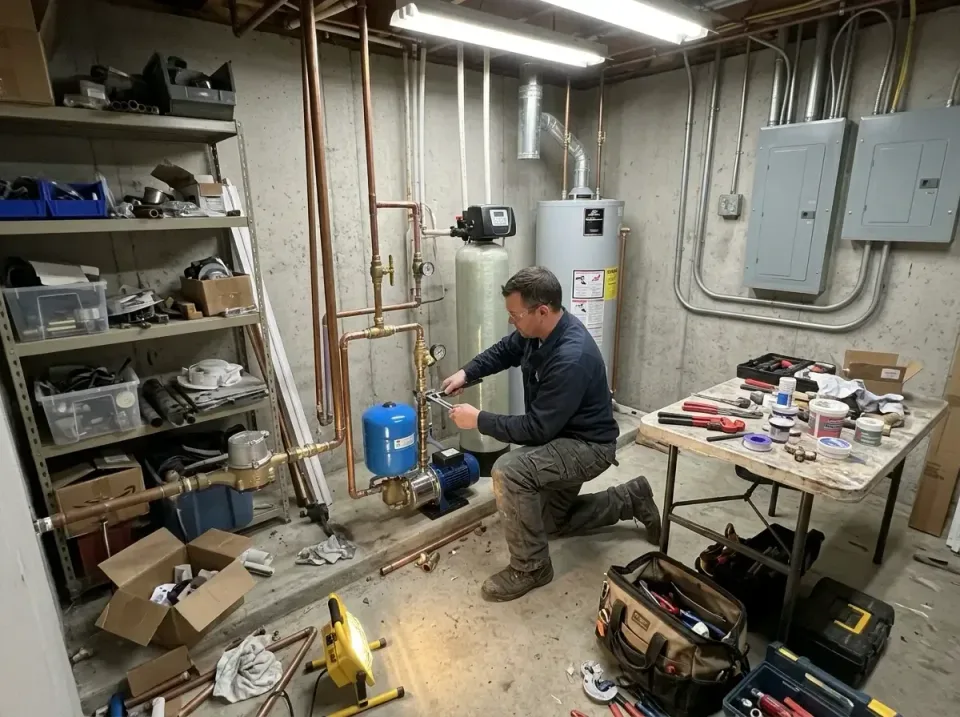
Pressure Tank Repair
We repair residential pressure tanks, checking tank capacity and connections; typical repairs or replacement run $300–$1,200, depending on tank size and access.
When upstairs faucets barely produce water, a Grundfos booster pump might help but only if the incoming supply and plumbing can support it. A pump cannot fix every cause of weak flow.
A well pump that cycles on and off points to a different problem than a steady pressure shortage, so the system needs testing before equipment is selected. That matters in North Dakota’s continental climate, where cold winters can expose vulnerable plumbing and interrupt service.
Our crew has worked on pressure problems around I-94 and knows that a pump added without diagnosis can leave the original fault untouched. Ask for measurements, the likely cause, and the proposed scope before work begins.
If the entire house has weak flow, or the upstairs taps struggle while lower fixtures work normally, a booster may be appropriate when testing confirms the supply pressure is inadequate. The pump adds pressure to water moving through the system; it does not clear a blockage or repair a leak. We look at the symptom across several fixtures before treating the upper floor as a standalone problem.
Sizing a booster pump for a home starts with the flow demand the household actually needs, not just the number of bathrooms. A pump selected for peak demand has to supply multiple fixtures without leaving the system undersized or unnecessarily forceful.
North Dakota Plumbing Pros checks the likely use pattern and available system information before recommending a model. Near the North Dakota Heritage Center & State Museum, as elsewhere across the state, long winter freezes can freeze exposed water pipes; a frozen or restricted section needs attention rather than added pumping force.
A booster pump’s required capacity depends on how much water fixtures draw at the same time. Sizing by flow demand means considering whether someone may run an upstairs shower while a faucet or appliance is in use; choosing only by pipe size can miss that real-world load. The pump’s impeller moves water, but the component alone does not determine whether the whole system will deliver the desired flow.
A right-sized selection matches the pump to the home’s supply and demand. Too little capacity may leave the upstairs taps weak; an unsuitable system can add complexity without correcting the actual restriction.
A pressure regulator and a booster also do different jobs: one controls pressure, while the other raises it. We confirm which condition applies before proposing installation.
A booster pump and a pressure tank are not interchangeable. A pump increases water pressure in a low-supply system, while a pressure tank stores pressurized water for a well system. If the home relies on a well, the tank and pump equipment need to be considered together rather than adding a booster as a shortcut.
The choice depends on what measurements and inspection show. A weak upper-floor faucet can reflect supply limitations, but a pressure loss across equipment or piping can produce a similar complaint.
That distinction affects both the repair plan and the equipment required. Spring freeze-thaw cycles can stress buried pipes in North Dakota, so a continuing supply problem may warrant checking for a damaged section before changing the pump arrangement.
You can note which fixtures lose flow and whether the symptom changes when other taps run. That observation helps narrow the investigation. Leave pump selection, plumbing connections, and electrical work to a qualified professional; a booster installation involves more than attaching a pump to a pipe.
We test before recommending repairs, explain the likely cause in plain language, and confirm scope before work begins. Our team can assess a proposed water booster pump installation and explain whether the system needs a pump at all.
Do not install a booster to mask an unexplained loss. A North Dakota winter can make exposed plumbing problems harder to reach, so plan repairs with seasonal conditions in mind.
If upstairs faucets weaken while other fixtures remain usable, the right repair depends on whether the source, controls, or fixture path is restricting delivery. Start with readings taken both with fixtures closed and while water runs; they answer different questions.
| Option | Best for | Key detail |
|---|---|---|
| Booster pump installation | Confirmed low-supply pressure | Choose a residential flow-rated model to match demand. |
| Well pump repair | A well system failing to deliver | Check pump operation before adding equipment. |
| Pressure regulator adjustment or replacement | Regulator limiting downstream supply | A regulator controls pressure; adjustment or replacement depends on its condition. |
| Fixture pressure troubleshooting | One or a few weak taps | Compare fixtures to locate a local restriction. |
A flowing reading shows how pressure behaves while water moves, unlike a static reading taken with fixtures closed. North Dakota’s warm summers can raise outdoor water demand, which may make a demand-related pressure complaint more noticeable. Ask the plumber what each reading indicates before approving equipment.
Before a pump visit, note which faucets are weak and whether the symptom changes during use. That record gives the plumber a useful starting point. In North Dakota, heavy snowfall can obstruct outdoor plumbing access, so clear a safe route to any outdoor equipment when conditions allow.
Confirm symptoms: Identify the affected upstairs fixtures and tell the plumber when flow changes.
Clear the work area: Move stored items away from the planned pump location and protect nearby finished floors.
Provide access: Make well equipment and the pressure tank accessible if the property uses a well.
Check electrical access: Confirm the work area can be reached safely so the installer can assess power needs.
Plan for interruption: Coordinate a temporary water shutoff with everyone at home.
Review commissioning: Ask how the booster pump will be set up and what tests will confirm operation.
Test fixtures: Have multiple fixtures checked after service so you can confirm water service is restored.
A pressure switch starts and stops a well pump; the installer should account for its role rather than treating it as a booster control. Seasonal temperature swings affect pipe expansion and contraction, making careful connections and follow-up checks worthwhile.
Yes, a booster may help if testing confirms a supply-pressure problem affecting the upper floor, but a local restriction can cause a similar symptom. North Dakota Plumbing Pros can compare fixture flow and discuss whether water pressure testing is the next step.
Pressure testing is $75–$200, with diagnostic time and access affecting the cost. Ask for readings at the affected fixtures and a written scope before deciding whether the pump installation is warranted.
A homeowner can document which fixtures are weak, but pump installation involves plumbing and electrical considerations that should be assessed by a professional. Call North Dakota Plumbing Pros when the cause is unclear or you need a system-specific installation recommendation.
The North Dakota Plumbing Code’s current edition should also be verified before work proceeds.
Yes, a regulator that limits downstream pressure can produce weak flow, so replacing it with a booster may not address the actual cause.
A Grundfos booster may help when testing shows that the home needs more supply pressure and the system can support the added pump. It will not correct every cause of weak upstairs flow. If shower pressure drops during use, hot water runs slower than cold, or pressure falls when appliances run, describe those specific patterns during the assessment; each can point to a different section of the plumbing.
North Dakota’s continental climate brings cold winters and warm summers, so do not ignore a pressure change that appears alongside other plumbing symptoms. North Dakota Plumbing Pros will test the system, explain the likely cause, and confirm the repair scope before work begins. Contact us about water booster pump installation and ask what testing supports the recommendation.
Yes, a booster may help if testing confirms a supply-pressure problem affecting the upper floor, but a local restriction can cause a similar symptom. North Dakota Plumbing Pros can compare fixture flow and discuss whether water pressure testing is the next step.
Pressure testing is $75–$200, with diagnostic time and access affecting the cost. Ask for readings at the affected fixtures and a written scope before deciding whether the pump installation is warranted.
A homeowner can document which fixtures are weak, but pump installation involves plumbing and electrical considerations that should be assessed by a professional. Call North Dakota Plumbing Pros when the cause is unclear or you need a system-specific installation recommendation.
The North Dakota Plumbing Code’s current edition should also be verified before work proceeds.
Yes, a regulator that limits downstream pressure can produce weak flow, so replacing it with a booster may not address the actual cause.
Browse all nationwide service options and choose the right fit for your project.
We repair residential pressure tanks, checking tank capacity and connections; typical repairs or replacement run $300–$1,200, depending on tank size and access.
We trace sudden whole-house pressure loss for homeowners, including accessible pipe and system checks; typical repairs run $150–$900, depending on pipe location and damage.
Burst Pipe Repair finds and replaces damaged supply pipe in homes and rentals; many straightforward repairs run about $200–$1,000, depending on access and damage.
We test residential and well-system pressure with a calibrated gauge; diagnostic time and access shape the typical charge.
Low well pressure diagnosis and repair for homeowners, including checks of the well system and pressure equipment; typical jobs run $250–$900 depending on access and parts.
Water Leak Repair for homeowners and property managers covers accessible pipe leaks and damaged sections; typical repairs run $150–$900, depending on pipe location and damage.
We repair residential water softeners with restricted-flow or valve issues; access to the unit and replacement-part needs shape the job estimate.
Select a city to find local low water pressure repair providers we cover in North Dakota.
Share your job scope for low water pressure repair in North Dakota — we will review fit and pricing before scheduling.